Hour 11:39
11 Feb 26
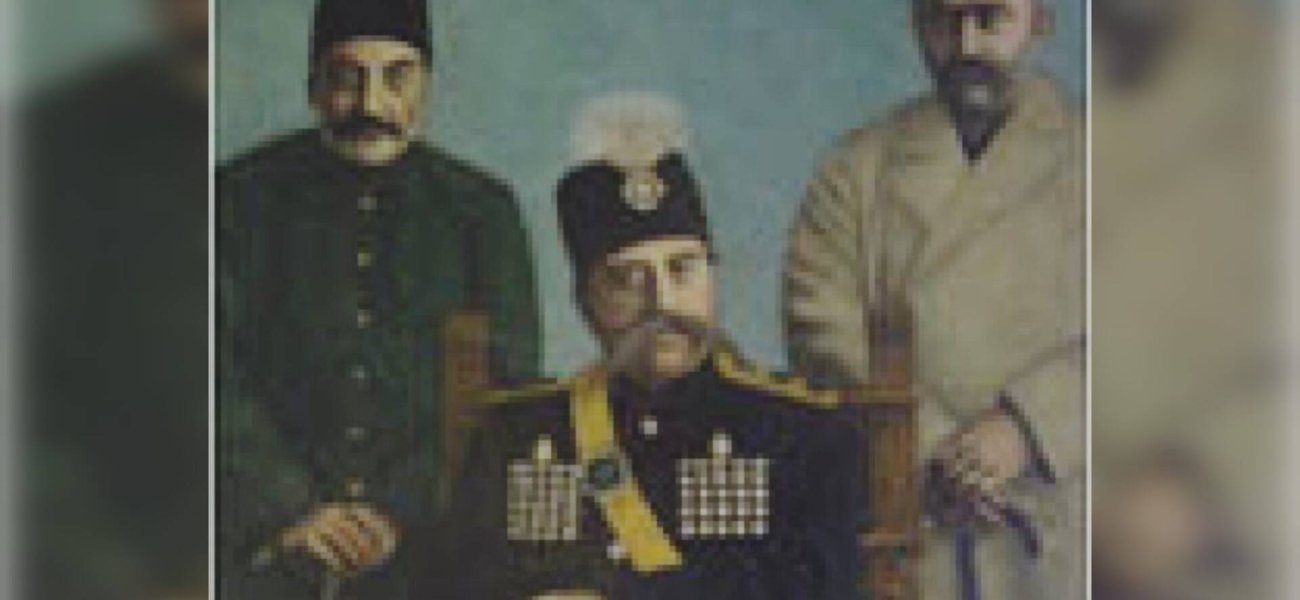
The portrait painting of Mozaffar al-Din Shah, Amin al-Soltan, and Abolqasem Khan Nasser al-Molk is located at the entrance of the western hall of the Sahebqaraniyeh Palace Museum.
The portrait painting of Mozaffar al-Din Shah, Amin al-Soltan, and Abolqasem Khan Nasser al-Molk is located at the entrance of the western hall of the Sahebqaraniyeh Palace Museum.
At the entrance of the western hall of the Sahebqaraniyeh Palace Museum, a unique portrait painting by Samsam ibn Zolfaghar, a court painter of the Qajar period, can be seen. In this work, in addition to Mozaffar al-Din Shah, the faces of two political figures of the Qajar era—Abolqasem Khan Nasser al-Molk and Mirza Ali Asghar Atabak, known as Amin al-Soltan—are depicted using the oil-on-canvas technique, with dimensions of 100 × 120 centimeters. The style of this work is the Qajar style, in which the figures are portrayed with particular grandeur, dignity, and splendor.
Samsam ibn Zolfaghar, known as Mirza Mehdi Mosavver al-Mamalek, was an Iranian painter, portraitist, and printer during the Qajar era and one of the well-known artists of the Naseri and Mozaffari periods. He lived in the late thirteenth and early fourteenth centuries AH.
In the year 1314 AH, Mirza Mehdi Khan was granted the title “Mosavver al-Molk” by Mozaffar al-Din Shah Qajar. He lived from the late Naseri period through the entire Mozaffari period and into the early reign of Mohammad Ali Shah Qajar.
He worked in all three fields of portrait painting, landscape painting from nature, and copying. His brushwork was refined, and he used relatively vivid colors. In most of his works, he focused on portraiture and ethnographic subjects using oil paint and watercolor. The illustrations of the newspaper Sharafat, which was considered one of the first illustrated state newspapers of the Qajar period, were drawn by Mehdi Mosavver al-Mamalek.
Portraiture was one of the other important subjects during the period of Qajar painting, intended for installation in official and governmental spaces. For example, portraits were depicted in seated poses on chairs, standing full-length, or seated cross-legged with a backrest. These paintings were specifically created for Qajar kings, princes, ministers, and other members of the court. In these portraits, attention to facial details and the representation of character was of primary importance.