Hour 10:05
10 Feb 26
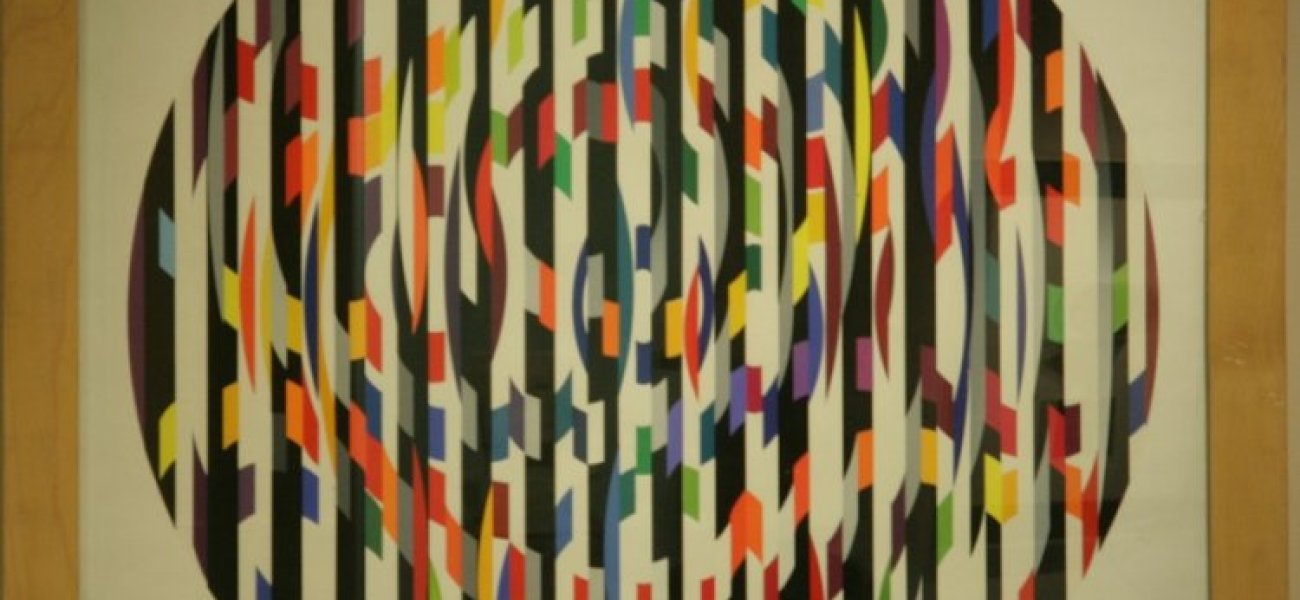
Yaacov Agam (born 1928) is a sculptor and experimental artist and one of the pioneers of Optical Art and Kinetic Art. He studied at the Bezalel Academy of Arts and Design in Jerusalem between 1947 and 1948,
Untitled
Artist: Yaacov Agam (1928)
Technique: Silkscreen print
Dimensions: 71 × 71 cm
Exhibition Venue: Jahan-Nama Museum
Yaacov Agam (born 1928) is a sculptor and experimental artist and one of the pioneers of Optical Art and Kinetic Art. He studied at the Bezalel Academy of Arts and Design in Jerusalem between 1947 and 1948, and continued his studies from 1949 to 1951 in Zurich and subsequently at the Atelier of Abstract Art in Paris (1951).
During his years of residence in Paris, he devoted much of his life to studying and identifying the various relationships between geometric abstract kinetic art and technique.
Yaacov Agam is a bold theoretician who, with his innovative and creative spirit, is undoubtedly one of the earliest creators of Optical Art. In his artworks, through the use of techniques that combine shapes, colors, and light, and with the aid of geometric forms, he is able to create a multitude of visual illusions and imaginations at a single focal point for the viewer, in such a way that by changing the viewing angle, the forms themselves change.
There is a sense of futurism in Agam’s works. This dynamism is the result of a completely personal interpretation of the Second Commandment of the Ten Commandments of Moses and the influence of Hebraism, which can be observed in the combination of colors and light in his works.
In 1953, Agam held his first solo exhibition in Paris, where he presented his earliest kinetic works. In the same year, he participated in an exhibition at the Denise René Gallery alongside Calder, Bury, Soto, Vasarely, Duchamp, and Tinguely. This exhibition is regarded as a significant event in the emergence of the Kinetic Movement or Kinetic Art. From this period onward, Agam became recognized as a creative figure in Abstract Art.
During the 1960s, Agam’s works were presented in all major exhibitions of kinetic art, offering a new visual language for the expression of modern art.
In 1963, he received the Special Prize for Art Research at the São Paulo Biennial, and in 1970 he was awarded the First Prize at the International Painting Festival of Cagnes-sur-Mer.
He also held exhibitions at the Tel Aviv Museum of Art and the National Museum of Modern Art in Paris. His works can be seen on the passenger ship Jerusalem, in the waiting hall of the Élysée Palace, at the Faculty of Science in Montpellier, the Presidential Palace in Jerusalem, and John F. Kennedy Airport in New York.
In 1996, Yaacov Agam was awarded the UNESCO Prize for Education and was invited to teach at the Carpenter Center for the Visual Arts at Harvard University. He also participated in numerous exhibitions and received many prestigious artistic awards.
Two works by Yaacov Agam are currently on display at the Jahan-Nama Museum of the Niavaran Cultural–Historical Complex.
Optical Art (Op Art)
Op Art (short for Optical Art) refers to a style of abstract painting associated with artists of the 1960s, which, through the use of specific visual phenomena, creates effects of vibration, oscillation, or visual movement within the artwork. In this style of painting, the creation of optical illusion is of central importance.
Artists associated with the Op Art movement organize sets of lines, small shapes, and bright colored surfaces in a systematic way to suggest movement (back and forth).
The most important source of inspiration for Op Art artists is the work of Josef Albers, particularly the series Homage to the Square.
After a long period of decline, Op Art techniques were revived in the 1980s. Among the artists of this movement are Victor Vasarely, Bridget Riley, Josef Albers, and Yaacov Agam.
Op Art continues its life in the works of Venezuelan artists Carlos Cruz-Diez and Jesús Rafael Soto.