Hour 13:16
03 Oct 26
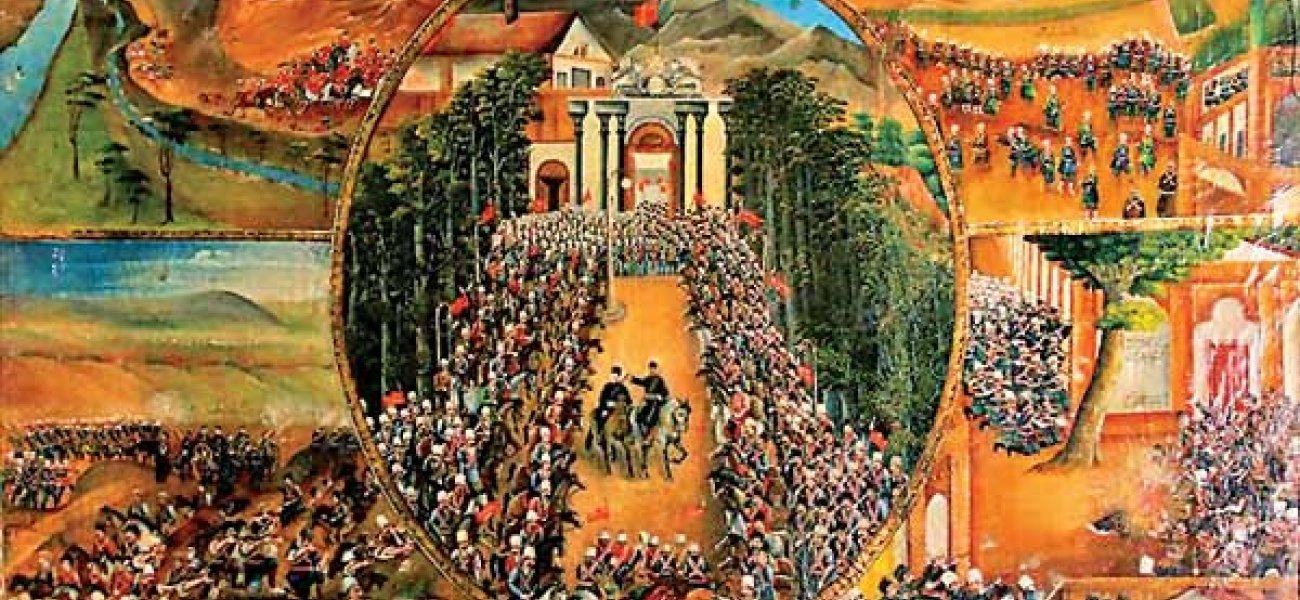
“The Conquerors of Tehran” is a narrative oil painting from the Constitutional era, created in 1909. The work depicts the historic capture of Tehran by the Bakhtiari and Gilan constitutionalist forces on July 19, 1909
“The Conquerors of Tehran”
Date: 1909 (1288 AH)
Artist: Unknown
Medium: Oil on canvas
Dimensions: 190 × 296 cm
Location: Sahibqaraniyeh Palace
“The Conquerors of Tehran” is a narrative oil painting from the Constitutional era, created in 1909. The work depicts the historic capture of Tehran by the Bakhtiari and Gilan constitutionalist forces on July 19, 1909—an event that led to the refuge of Mohammad Ali Shah in the Russian Embassy and his subsequent deposition during the Persian Constitutional Revolution.
Executed in the narrative style widely favored in the Qajar period, the painting illustrates five key episodes related to the conquest of Tehran. At the center, within an oval frame, two prominent constitutionalist leaders—Masoud Valikhan and Ali-Qoli Khan Sardar Asad Bakhtiari—are shown on horseback entering the National Assembly, surrounded by cavalry bearing red flags inscribed “Long Live the Bakhtiari Mujahidin.”
The four surrounding scenes portray significant battles: the engagement at the Khandaq earthworks, the conflict between Bakhtiari and constitutionalist forces and their opponents, the Battle of Badamak, and the confrontation between the constitutionalists and the Cossacks near Karaj Bridge.
The composition is divided horizontally, with ornamental golden bands and calligraphic cartouches separating the narrative sections. The upper inscription, written in Nastaliq script, records the leaders’ entry into the “Sacred National Assembly” in Jumada al-Thani 1327 AH.
The painting employs vivid, pure pigments—vermilion reds, Prussian blue, greens, and ochres—typical of late Qajar narrative works. Figures are rendered in a largely schematic manner, mostly in profile, with minimal individual differentiation. Notably, photographic images of the two principal leaders were incorporated through collage, enhancing the documentary character of the composition.
Beyond its aesthetic qualities, this painting serves as a significant visual document of one of the most decisive moments in modern Iranian history.